wecan01@wecan-machine.com
+86-18825990919
+86-07502632972

Motor manufacturing depends on a connected group of machines rather than one standalone unit. From lamination forming to stator assembly, rotor preparation, bearing insertion, housing riveting, screw locking, testing, and final transfer, every step affects dimensional accuracy, electrical performance, and production stability. This is why buyers usually evaluate not only a single machine, but the full logic of the line. Electric motor systems are also one of the largest electricity uses in the world, accounting for more than 40 percent of global electricity consumption according to the IEA, which makes production quality and efficiency even more important for downstream industries.
A motor contains multiple precision parts that must match tightly during assembly. The stator core must be formed and inserted correctly. The rotor must be laminated, compacted, and checked for alignment. Bearings, circlips, housings, and fasteners must be installed with controlled force and repeatable positioning. Final testing must confirm that the finished unit meets the required operating standard. International standards such as IEC 60034 and ANSI NEMA MG 1 are widely used in the industry to define rating, performance, and application expectations for rotating electrical machines, which means production equipment must support consistent, measurable results.
A complete motor manufacturing machine setup usually includes several equipment categories working in sequence. The exact configuration depends on motor type, output, and target capacity, but the following machines are commonly used across modern lines.
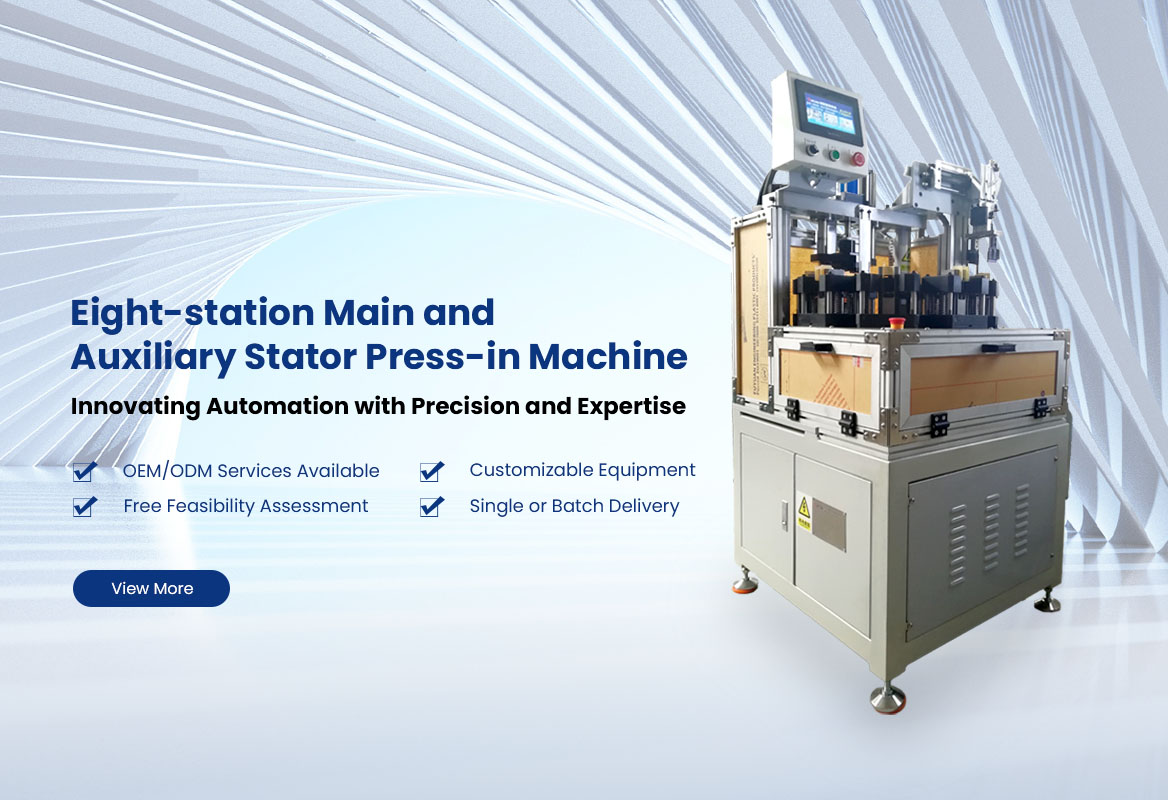
Stator press and insertion machines are used to rivet or insert stator components accurately and repeatedly. These machines are critical for shaded-pole motors and inner-wound stator motors where assembly precision directly affects magnetic performance and product consistency. On the WECAN website, its four-station and eight-station stator press and insertion equipment is presented as a solution for safer operation and higher efficiency, with the eight-station model described as reaching about three times the efficiency of manual work. That kind of process improvement is valuable when factories need to reduce labor dependence while keeping assembly stable over long runs.
Servo press machines are used for force-controlled insertion and riveting tasks such as motor bearing insertion, motor housing riveting, and stator joining. Compared with conventional pressing methods, servo-driven systems help control stroke and pressure more precisely, which is important when the process window is narrow. WECAN positions its servo press machine for motor, automotive, and home appliance applications, highlighting PLC control, pressure accuracy, and efficient operation. For manufacturers, this type of equipment helps reduce variation between batches and supports more stable line qualification.
Rotor laminating machines are used in the later stage of stator and rotor production to complete shaping, compaction, misalignment detection, and screening. This step matters because poor rotor stack quality can lead to imbalance, vibration, or performance loss in the finished motor. WECAN lists both automatic rotor laminating machines and rotor automatic lamination machines for this purpose, showing its focus on the accuracy of core component preparation before final assembly. In practical terms, this machine protects the line from passing unstable parts to downstream operations.
Bearing and circlip insertion is a small step with a large effect on product durability and assembly speed. Manual installation often creates inconsistency in seating depth, force, and cycle time. WECAN offers an automatic circlip installation machine with claimed work efficiency of more than two times manual operation, and also an automatic bearing and circlip insertion machine that combines two processes into one. For factories planning motor assembly line automation system upgrades, this type of combined station is valuable because it cuts handling steps and reduces operator dependency.
Before core assembly, manufacturers also need precision forming and edge control. Precision servo stamping machines support repeatable forming for parts used in motor production. Deburring machines remove burrs and sharp edges that could affect fit, safety, insulation integrity, or later assembly steps. WECAN includes both deburring and precision servo stamping equipment within its Electric Motor Equipment category, which shows a broader understanding of upstream and midstream process control rather than only final assembly.
For higher output and better process integration, manufacturers often move from single stations to a full industrial motor assembly line. WECAN lists an automatic inverter motor production line that can complete stator and rotor assembly, housing riveting, bearing insertion, screw locking, and testing in one connected workflow. This layout supports smoother material flow, reduced manual transfer, and more stable takt control. When comparing suppliers, buyers should pay attention to whether the line is only a collection of machines or a truly coordinated system with unified logic, safety, and data control.
The table below shows how different machine types fit into a typical motor production process.
| Production Stage | Key Machine | Main Purpose |
|---|---|---|
| Core forming and preparation | Precision servo stamping machine | Produces accurate metal parts for later assembly |
| Edge finishing | Deburring machine | Removes burrs and improves part safety and fit |
| Stator assembly | Four-station or eight-station stator press and insertion machine | Rivets and assembles stator parts with repeatable force |
| Rotor preparation | Automatic rotor laminating machine | Shapes, compacts, checks misalignment, and screens parts |
| Bearing and circlip assembly | Automatic bearing and circlip insertion machine | Integrates two operations and reduces handling |
| Press-fit and riveting | Servo press machine | Controls stroke and pressure in critical insertion tasks |
| Final assembly and inspection | Automatic inverter motor production line | Completes assembly, fastening, and testing in one flow |
Choosing motor production equipment should begin with process matching. A factory producing shaded-pole motors may need a different stator solution from a factory producing inverter motor products. Capacity target, labor structure, available floor space, and acceptable cycle time should all be confirmed before machine selection.
The second point is process integration. Machines that run well as stand-alone units may still create bottlenecks if feeding, transfer, or inspection logic is weak. A qualified motor manufacturing equipment supplier should be able to explain how each station connects to the next, how changeover is handled, and how testing data supports quality release.
The third point is control stability. Electric motors are widely governed by performance and efficiency requirements, and regulations continue to move toward higher energy expectations in major markets. The U.S. Department of Energy has continued updating electric motor efficiency standards, while IEC frameworks remain fundamental for rotating machine rating and performance. That makes production repeatability a purchasing issue, not just an engineering issue.
WECAN is not positioned as a general equipment trader. Its website shows dedicated categories for electric motor equipment, CNC Equipment, EPE Processing Equipment, and clothes hanger machinery, with the company describing more than 12 years of experience in automation equipment, automation design, and control design. That background matters because motor lines require not only mechanical structure, but also motion control, safety logic, and integrated process thinking. Even a category such as hanger making machine demonstrates WECAN’s broader experience in automated material handling and specialized equipment development, which supports its engineering capability across different industrial production scenarios.
For motor manufacturers, WECAN’s advantage is the breadth of equipment already shown within one product family. From stator pressing to rotor lamination, from servo pressing to automatic bearing and circlip insertion, and from single stations to complete inverter motor lines, the company presents a more complete path for factories that want to scale from manual work to automation in stages. That can make project planning clearer and reduce communication gaps during equipment selection.
Machines used for motor manufacturing are part of one production system built around precision, repeatability, and line efficiency. Stator press machines, servo presses, rotor laminating machines, bearing and circlip insertion equipment, deburring systems, stamping machines, and automatic final assembly lines each solve a different point in the process. The right solution is the one that matches product type, output target, and quality expectation while leaving room for future automation upgrades.
WECAN’s electric motor equipment portfolio shows that it understands this logic from the machine level to the line level. For companies planning a new motor project or upgrading an existing production flow, that kind of integrated equipment capability creates a stronger foundation for stable output, controlled labor cost, and long-term manufacturing consistency.
Previous: How Does EPE Foam Machine Work?