wecan01@wecan-machine.com
+86-18825990919
+86-07502632972

Efficient motor manufacturing depends on precision, consistency, and production speed. Selecting the right motor assembly machine directly impacts product quality, cycle time, and long-term operational cost. With increasing demand for high-performance electric motors across industries, manufacturers must evaluate equipment based on both technical capability and production scalability.
Motor assembly involves multiple stages including pressing, fitting, alignment, and testing. Each step requires strict tolerance control to ensure stable motor performance. According to data from the International Energy Agency, global electric motor demand continues to grow with industrial motor systems accounting for nearly 45 percent of total electricity consumption. This trend pushes manufacturers to adopt more advanced assembly solutions.
Before selecting equipment, it is essential to define:
Production volume and cycle time expectations
Motor type and structural complexity
Required precision level for assembly
Integration with existing production lines
These factors determine whether a standard machine or a customized solution is more suitable.
A complete Electric Motor Equipment setup may include several specialized units working together:
Rotor and stator assembly machines
Shaft pressing systems
Bearing installation units
Final testing and inspection stations
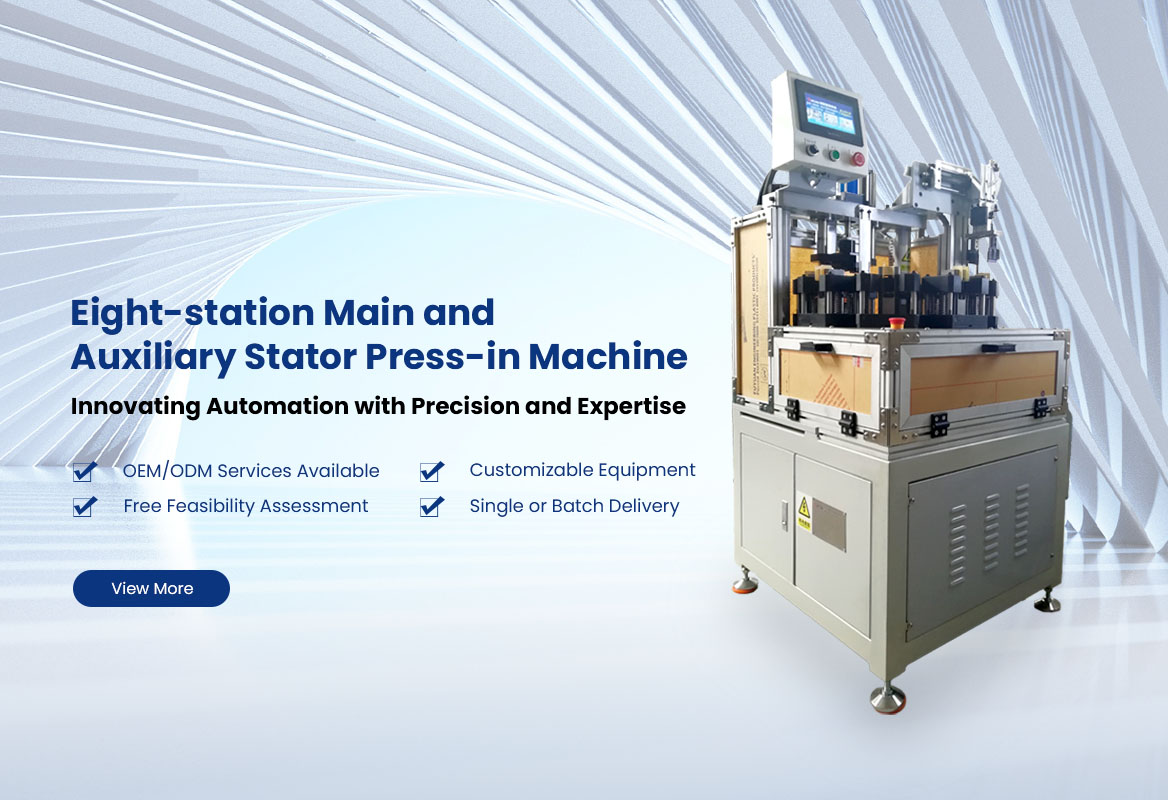
Among these, the automated servo press for motor assembly plays a critical role. It ensures accurate force control during pressing operations, preventing component damage while maintaining consistent assembly quality. Servo-driven systems also provide better repeatability compared to traditional hydraulic presses.
High-precision assembly ensures long motor lifespan and stable performance. Advanced machines equipped with servo control systems can achieve micron-level accuracy, reducing misalignment and vibration issues.
Automation significantly improves throughput. Industry studies show that automated motor production machine lines can increase output by over 30 percent while maintaining consistent quality across batches.
Manufacturers often need to handle multiple motor models. Equipment should support quick changeover and adjustable parameters to accommodate different specifications without major downtime.
Energy-efficient machines reduce operating costs over time. Modern systems are designed to optimize power usage while maintaining high performance.
Reliable equipment minimizes downtime. Easy access to key components and clear maintenance procedures are essential for long-term operation.
| Factor | Manual Assembly | Automated Assembly |
|---|---|---|
| Precision Control | Operator dependent | High consistency |
| Production Speed | Limited | High throughput |
| Labor Requirement | High | Reduced |
| Defect Rate | Higher | Lower |
| Scalability | Limited | Strong |
This comparison highlights the advantages of automation for manufacturers aiming to improve factory production efficiency and product reliability.
Automation transforms traditional assembly into a continuous and controlled process. A well-designed system integrates multiple stations, allowing seamless transfer of components from one stage to another.
A motor assembly automation equipment factory setup enables:
Reduced manual handling errors
Improved process consistency
Faster production cycles
Better data tracking and quality control
These benefits are especially important in high-volume production environments where stability and repeatability are critical.
Selecting a reliable electric motor production machine supplier is just as important as choosing the machine itself. A strong supplier provides not only equipment but also technical expertise and long-term support.
Key considerations include:
Engineering capability and customization options
Experience in similar production applications
After-sales service and technical support
Ability to provide complete production line solutions
Working with a supplier that understands real manufacturing challenges ensures smoother implementation and faster return on investment.
WECAN focuses on delivering integrated and practical automation solutions tailored to actual production needs. By combining mechanical design, control systems, and process optimization, the company provides reliable motor assembly systems that enhance both efficiency and quality.
Core strengths include:
Customized machine configurations based on product requirements
Stable performance for continuous operation
Efficient system integration across multiple production stages
Technical support from installation to full-scale production
This approach ensures that each system functions as part of a coordinated production line rather than as isolated equipment.
To make a well-informed decision, manufacturers can follow a structured evaluation process:
Define production targets and quality standards
Analyze motor design and assembly complexity
Compare automation levels and system capabilities
Evaluate total cost including operation and maintenance
Plan for future production expansion
A systematic approach helps avoid underinvestment or overconfiguration, ensuring the selected equipment aligns with long-term production strategy.
Choosing the right motor assembly equipment requires a balance between precision, efficiency, and scalability. Advanced automation systems provide clear advantages in output consistency and operational stability. With proper evaluation and the right technical partner, manufacturers can build a reliable assembly process that supports continuous growth and competitive performance.