wecan01@wecan-machine.com
+86-18825990919
+86-07502632972

Repeatable stamping requires every component to receive the correct force, stroke, speed, and final position. Conventional pneumatic or mechanical pressing may deliver acceptable output, but variations in material thickness, component fit, tooling condition, and operator setup can still change the result. A Precision Servo Stamping Machine turns these variables into programmable process parameters that can be monitored across long production runs.
Reaching the same mechanical stop does not prove that every part was assembled correctly. A tilted bearing, oversized shaft, damaged housing, or misplaced component can reach the intended position while receiving abnormal force.
Servo-driven systems allow the press head to follow a defined motion profile. Engineers can control the approach, pressing stage, holding position, and return stroke according to the application. This is useful for motor shaft riveting, bearing insertion, housing assembly, bending, and other operations where product damage may occur inside a narrow process window.
A stable repeatable metal stamping process should consider the relationship between pressure and movement. Force that rises earlier than expected may indicate interference, misalignment, or an incorrect component. Lower resistance can suggest loose fit or missing material.
| Process signal | Possible condition | Recommended response |
|---|---|---|
| Early force increase | Tilted or oversized component | Stop and inspect positioning |
| Low peak force | Insufficient interference | Check component dimensions |
| Correct force but short stroke | Obstruction or incorrect loading | Inspect fixture and tooling |
| Excessive final stroke | Undersized component or setup error | Verify recipe and material |
| Gradual force change | Tool wear or material drift | Review trend and maintenance |
Monitoring these patterns provides more information than final dimensional inspection alone.
Factories producing several parts should store validated parameters by product number. Each recipe may include pressing force, stroke, speed, dwell time, acceptance limits, fixture code, and inspection frequency.
Recipe control reduces the risk of operators entering different settings between shifts. Access levels can also prevent unauthorized parameter changes after the process has been approved.
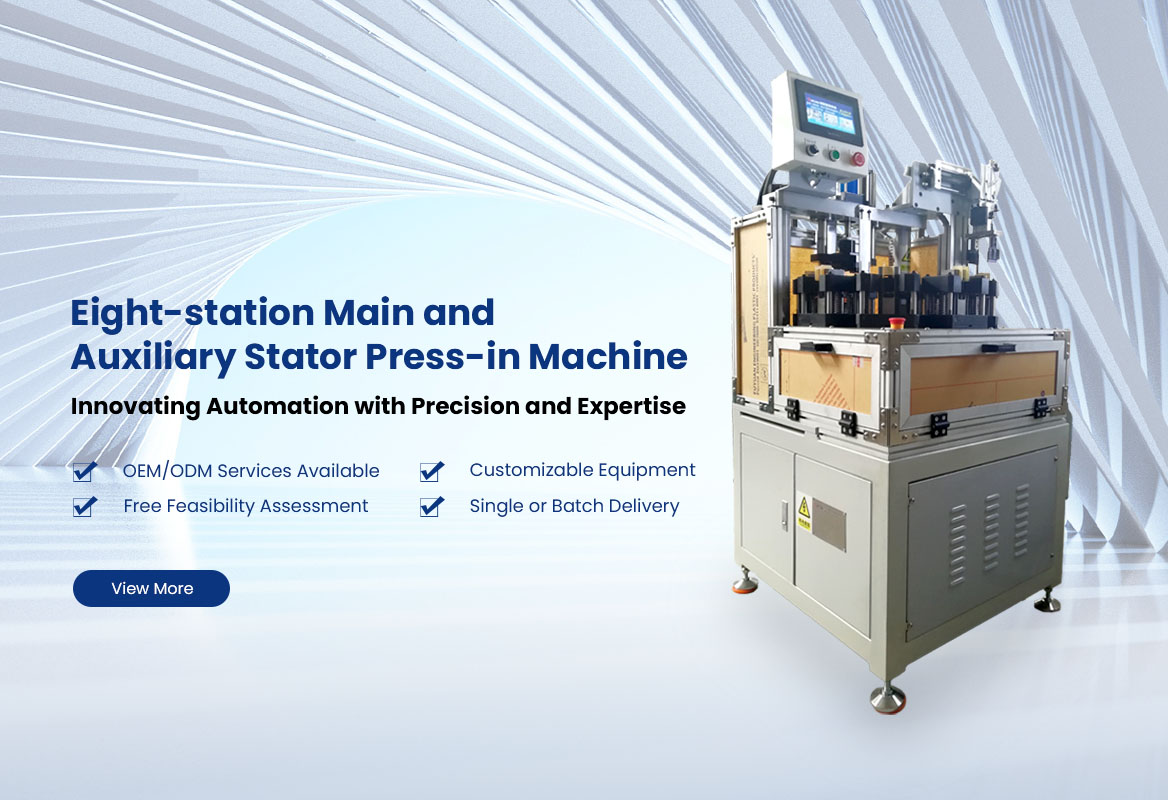
WECAN’s servo stamping equipment uses an AC servo motor, low-backlash ball screw, high-sensitivity sensors, and PLC control. Published performance includes repeat accuracy of 0.02 mm and a cycle of approximately four to five seconds per piece under specified conditions.
Servo control cannot correct unstable fixtures or severely inconsistent parts. Tooling should support the component near the pressing area and maintain coaxial alignment throughout the stroke.
Automotive parts manufacturing plants should connect press data with incoming material dimensions, tooling history, and downstream inspection. This helps distinguish a machine problem from a component tolerance issue.
Force and position values should be reviewed over time. A gradual shift may reveal tooling wear, lubrication changes, or material differences before parts exceed the rejection limit.
Useful production indicators include first-pass acceptance, average force, displacement variation, cycle time, alarm frequency, and defects by product model. Maintenance can then be planned according to actual process behavior.
A precision servo stamping machine improves repeatability by making critical settings measurable, programmable, and comparable. Combined with rigid fixtures and controlled components, it supports consistent pressing quality while reducing adjustment, rework, and operator-dependent variation.