wecan01@wecan-machine.com
+86-18825990919
+86-07502632972

Stator riveting determines how securely the main and auxiliary stator components remain positioned during assembly and operation. Incorrect pressure, angular deviation, loose joints, or distorted laminations can affect air-gap consistency and create vibration, noise, or electrical performance variation. For small motor production factories, riveting is therefore a functional quality process rather than a simple fastening step.
A stator must maintain its designed geometry after it is installed inside the motor housing. Loose riveting can allow components to shift during transportation, final assembly, or operation. Excessive riveting force can deform the stack, damage locating features, or change critical dimensions.
These problems may not be visible during basic appearance inspection. They often become apparent during rotor insertion, motor testing, or long-term operation, when the cost of correction is already much higher.
Factories commonly encounter several problems:
Rivet height differs between products
Stator components are not fully seated
Pressure marks appear around the joining area
Laminations become tilted or distorted
The main and auxiliary stators lose alignment
Assemblies loosen during vibration testing
Each defect should be linked to a specific possible cause. Low pressure may leave the joint incomplete, while excessive pressure can damage the component. Angular errors often indicate poor fixture alignment or incorrect loading.
The fixture must support the stator without forcing it into an unnatural position. Locating surfaces should reference stable component features, and the workpiece should remain fixed throughout the pressing cycle.
Wood chips are not the problem here, but metal fragments, burrs, oil residue, and worn locating pins can still change the assembly position. Cleaning and fixture verification should be included in routine production control.
A stator riveting machine can separate loading, positioning, riveting, and unloading into defined operations. This reduces differences caused by manual handling and makes production rhythm more predictable.
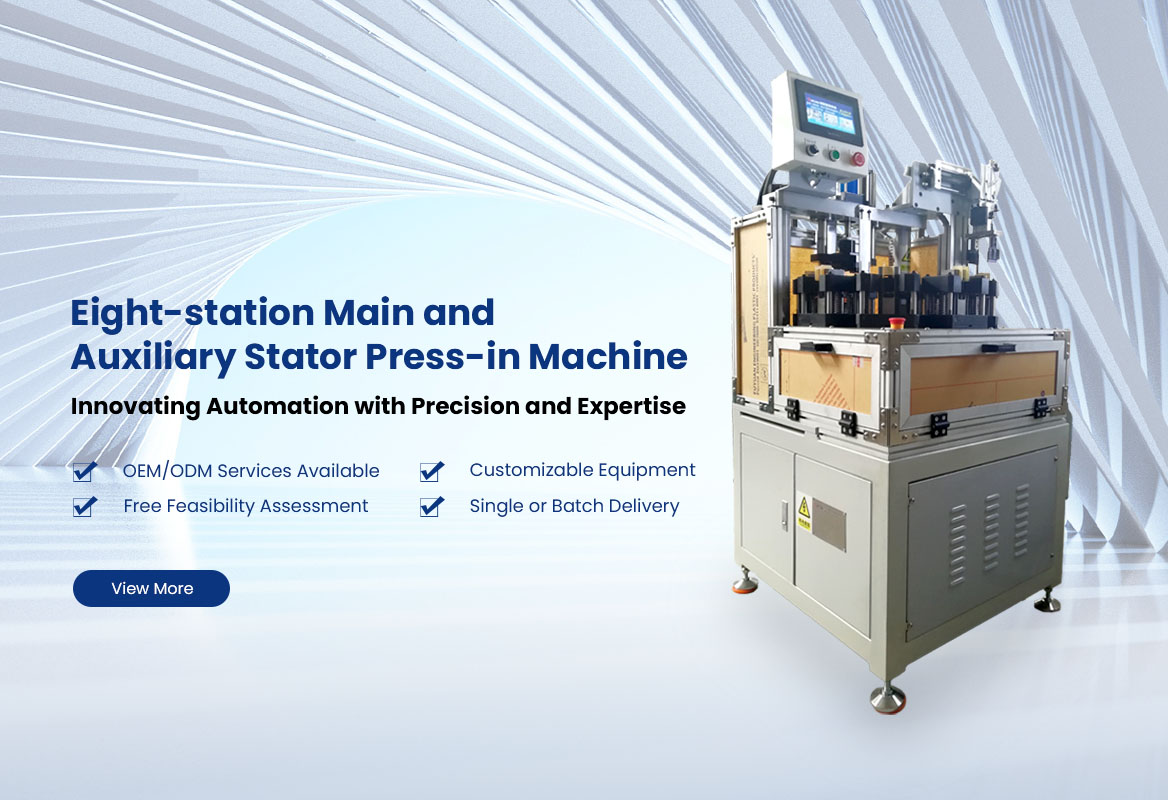
WECAN’s eight-station equipment is intended for riveting main and auxiliary stators used in shaded-pole, external-rotor, and related motor applications. Its rotary design separates the operator from the active riveting position. The published working cycle is approximately 2.3 to 3 seconds per piece, and compatible 48, 58, and 60 series can be changed within about five minutes.
Material sensing is another useful safeguard. When no component is detected at the workstation, the pressure head stops rather than completing an empty or incorrect pressing cycle.
The most useful controls combine process checks with product checks. The relationship can be summarized as follows:
| Control point | What it prevents |
|---|---|
| Component presence detection | Empty pressing and missing parts |
| Fixture position check | Tilted or off-center riveting |
| Stable pressure setting | Loose joints or component deformation |
| First-piece inspection | Incorrect changeover parameters |
| Tooling wear monitoring | Gradual loss of dimensional accuracy |
| Final motor testing | Undetected vibration or noise problems |
Production records should include model, fixture, pressure setting, output, rejection type, and tooling replacement history. Rising defect rates can then be traced before an entire batch is affected.
Dimensional inspection confirms whether the stator was assembled correctly, but downstream testing shows whether the process supports motor performance. Rotor clearance, motor current, vibration, noise, and running stability can all provide evidence of riveting consistency.
Better results come from aligning component tolerances, fixtures, machine settings, sensing, and inspection. A stable stator riveting machine helps manufacturers control these variables at the assembly stage, where defects are less expensive to detect and correct.