wecan01@wecan-machine.com
+86-18825990919
+86-07502632972

Factory managers are paying more attention to automation because production pressure is no longer caused by one single issue. Labor cost, delivery speed, product consistency, material waste, safety control, and capacity planning all affect daily operations. A factory automation production system is designed to connect these challenges into one controlled production workflow, rather than improving only one machine or one workstation.
The International Federation of Robotics reported that global industrial robot installations reached more than 500,000 units in recent annual data, showing that automated production is becoming a common direction for modern manufacturing. At the same time, many factories do not begin with a full unmanned workshop. They usually start by automating high-frequency processes, then expand into semi-automatic or fully automatic production lines.
A factory automation production system is a connected set of machines, control units, fixtures, sensors, conveying devices, software logic, and operating procedures. Its purpose is to make materials, parts, and finished products move through production steps with less manual interruption.
This type of system may include automatic feeding, positioning, assembly, pressing, drilling, cutting, inspection, sorting, stacking, and transfer. The system can be designed as one complete line or as several independent machines connected by conveyors or operators.
For a manufacturer, the key is not only whether the line looks advanced. The real value comes from whether the system can solve actual production problems, such as unstable output, repeated manual errors, long changeover time, high training cost, or low process visibility.
A complete automation system is usually built from several functional modules. Each module has a clear task, and the final performance depends on how well these modules work together.
| System Part | Main Function | Production Value |
|---|---|---|
| Feeding unit | Sends materials or parts into the machine | Reduces manual loading pressure |
| Positioning unit | Keeps parts in the correct place | Improves accuracy and repeatability |
| Processing unit | Completes drilling, pressing, assembly, forming, or cutting | Stabilizes key production actions |
| Control system | Manages machine sequence and parameter settings | Makes operation more predictable |
| Detection unit | Checks position, movement, or basic quality signals | Reduces hidden process risks |
| Transfer unit | Moves products between steps | Improves line continuity |
WECAN designs equipment for hanger production, electric motor production, EPE processing, CNC processing, and related automated machinery. These applications require different module combinations, so the system should be planned according to product structure and production rhythm.
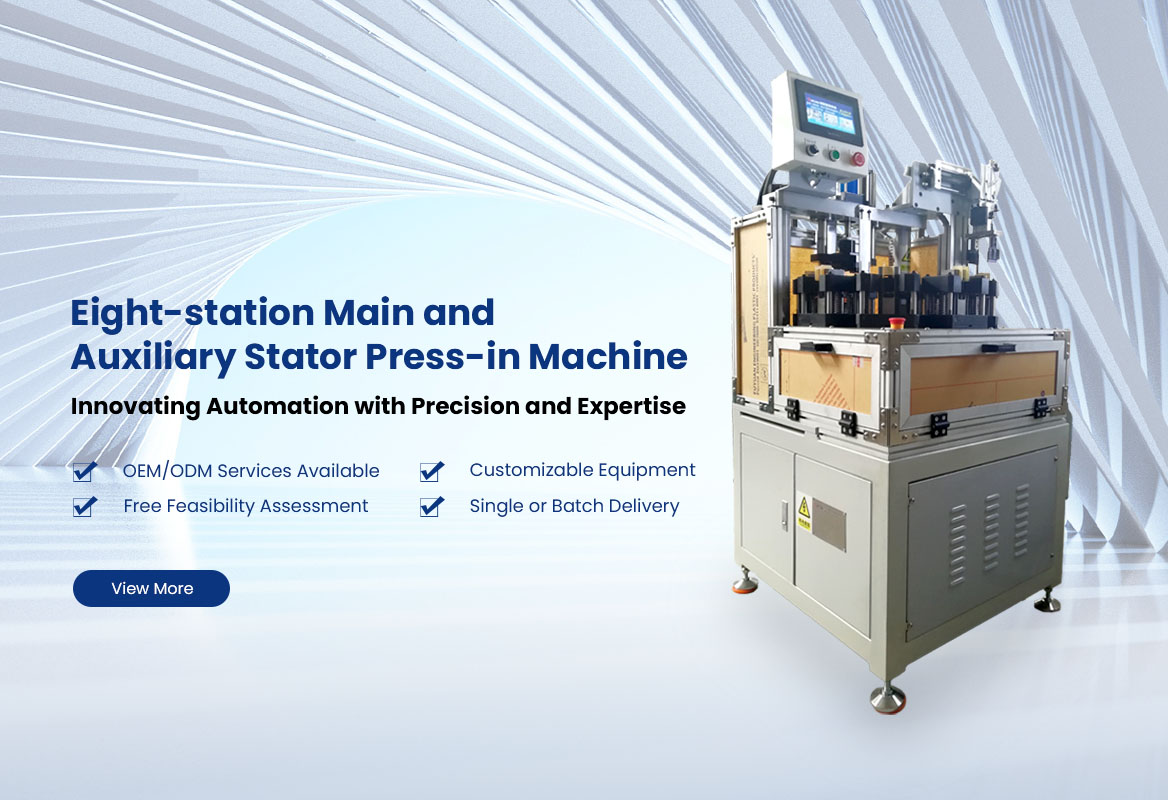
An industrial automation machine is often one important part of the larger system. It may complete a specific process such as hanger assembly, stator pressing, hook installation, CNC cutting, foam material processing, or component insertion.
Standalone machines can already improve a single bottleneck. However, when several machines are connected into a production system, the factory can achieve stronger workflow control. For example, one machine may complete feeding and positioning, another may perform assembly, and the next step may transfer products for checking or packing.
This structure helps factories avoid scattered production management. Instead of depending on separate manual coordination between each step, the system creates a more stable rhythm from raw material handling to finished product output.
A smart manufacturing system focuses on visibility, control, and adjustment. It does not only make machines move automatically. It also helps operators and managers understand production status more clearly.
In daily operation, smart functions may include touch-screen control, parameter storage, alarm reminders, sensor feedback, counting functions, servo positioning, and process sequence management. These functions help reduce guesswork during production.
For factories with multiple product sizes, parameter management is especially useful. Operators can reduce repeated manual adjustment by using preset data, while maintenance teams can locate abnormal conditions more quickly. This improves both production efficiency and workshop management.
Different factories invest in automation for different reasons, but most goals are related to long-term stability. A line that depends too much on manual work can face unstable output when workers change shifts, training is incomplete, or order volume increases suddenly.
Automation production systems help solve this problem by making key actions more standardized. Machines do not replace all decision-making, but they can keep repeated operations within set parameters. This is valuable for products that require consistent size, pressure, angle, depth, assembly position, or cycle time.
According to Deloitte’s manufacturing industry research, many manufacturers are increasing investment in smart factory and digital production capabilities to improve resilience, productivity, and operational visibility. This reflects a broader shift from simple machine purchasing to systematic production improvement.
As a factory automation production system supplier, WECAN focuses on matching machines with actual production scenarios. The company does not only provide single equipment categories, but also supports production planning across Home And Clothes Hanger Equipment, Electric Motor Equipment, EPE equipment, CNC Equipment, and robot-integrated applications.
A practical automation production line solution should begin with the product sample, process requirement, output target, material condition, workshop space, and future expansion plan. After these details are clear, the equipment structure can be planned more accurately.
WECAN’s advantage lies in combining mechanical design, electrical control, tooling configuration, assembly debugging, and production understanding. This helps reduce the risk of buying a machine that looks suitable but cannot run smoothly in real factory conditions.
Before ordering an automation system, manufacturers should clarify several practical points:
Which process currently limits production capacity?
Which step creates the highest defect risk?
What product sizes must the system cover?
What output per shift is required?
How much workshop space is available?
Does the system need future connection with other machines?
What level of operator training is acceptable?
These questions help prevent over-design and under-design. A system that is too simple may not solve the main bottleneck, while a system that is too complex may increase cost and maintenance pressure.
A factory automation production system is used to connect machines, controls, workers, and production processes into a more stable manufacturing workflow. It improves output consistency, reduces manual dependence, strengthens process control, and supports long-term capacity growth.
For manufacturers planning automation upgrades, WECAN provides practical machine design and production line support based on real factory applications. With the right system planning, automation becomes more than equipment investment. It becomes a structured way to build stronger, more predictable, and more competitive production capability.