wecan01@wecan-machine.com
+86-18825990919
+86-07502632972

Selecting the right motor assembly machine is a decision that directly impacts production efficiency, product consistency, and long-term operating cost. Electric motors are used across industries such as home appliances, automotive systems, and industrial equipment, and their performance depends heavily on assembly precision. A well-matched machine setup ensures stable output, while a poor choice often leads to rework, downtime, and inconsistent quality.
Global demand for electric motors continues to grow alongside electrification trends. Data from the International Energy Agency shows that motor-driven systems account for a significant portion of industrial electricity usage, which increases the need for reliable and efficient production processes. This makes equipment selection a strategic step rather than a simple procurement task.
Motor assembly machines are not universal. The first step is to define the type of motor being produced. Different motor structures require different assembly processes.
Small shaded-pole motors rely heavily on stator pressing and insertion accuracy. Brushless motors often require more precise rotor balancing and electronic integration. Induction motors demand consistent bearing installation and housing alignment.
A clear process map should include:
Stator assembly method
Rotor preparation steps
Bearing and circlip installation
Housing riveting or fastening
Final testing and inspection
Matching machine functions to these steps ensures the equipment supports actual production needs rather than adding unnecessary complexity.
Automation level determines both production capacity and labor dependency. A standalone machine may solve a specific task, but it can create bottlenecks if upstream and downstream processes are not aligned.
There are generally three levels of automation:
Semi-automatic machines with manual loading
Standalone automatic stations for key processes
Fully integrated assembly lines with synchronized workflow
For growing manufacturers, a modular approach is often more practical. Starting with key automation stations such as bearing insertion or stator pressing allows gradual upgrades toward a full production line.
Motor performance depends on tight tolerances. Even small variations in assembly force, alignment, or positioning can affect noise, vibration, and efficiency.
When evaluating machines, key technical indicators include:
Pressing force control accuracy
Positioning repeatability
Cycle time stability
Defect rate under continuous operation
Servo-driven systems are widely used because they provide better control over motion and force compared with traditional mechanical systems. This improves consistency across large production batches.
A motor assembly machine should not be evaluated in isolation. It must fit into a broader production workflow. Poor integration leads to idle time, manual intervention, and higher operational cost.
A well-designed system should support:
Smooth material transfer between stations
Unified control logic across machines
Flexible changeover for different models
Real-time monitoring of production status
manufacturers increasingly prefer equipment that can be connected into a coordinated production line rather than separate standalone units.
Machine performance is only part of the decision. The supplier’s engineering capability determines how well the equipment can be adapted to real production conditions.
A qualified supplier should be able to:
Provide customized solutions based on motor structure
Adjust machine parameters for different product variants
Offer stable control systems and software support
Deliver consistent machine quality across multiple units
For example, a company that also works as a hanger assembly machine supplier often demonstrates broader experience in automation design and high-speed assembly systems. This cross-industry capability can be valuable when dealing with complex production requirements.
Initial purchase price is only one part of the total cost. Long-term factors often have a greater impact on overall investment value.
Important considerations include:
Maintenance frequency and spare parts availability
Energy consumption during operation
Labor cost reduction through automation
Production efficiency and output consistency
A machine with higher upfront cost but better stability and efficiency can deliver lower total cost over its lifecycle.
| Factor | What to Evaluate | Why It Matters |
|---|---|---|
| Process compatibility | Match with motor type and structure | Ensures correct assembly method |
| Automation level | Manual, semi-auto, or full line | Affects labor and capacity |
| Precision control | Force, position, repeatability | Determines product quality |
| Integration ability | Workflow and system connectivity | Improves production efficiency |
| Supplier capability | Engineering and customization | Supports long-term operation |
| Total cost | Maintenance and efficiency | Impacts overall profitability |
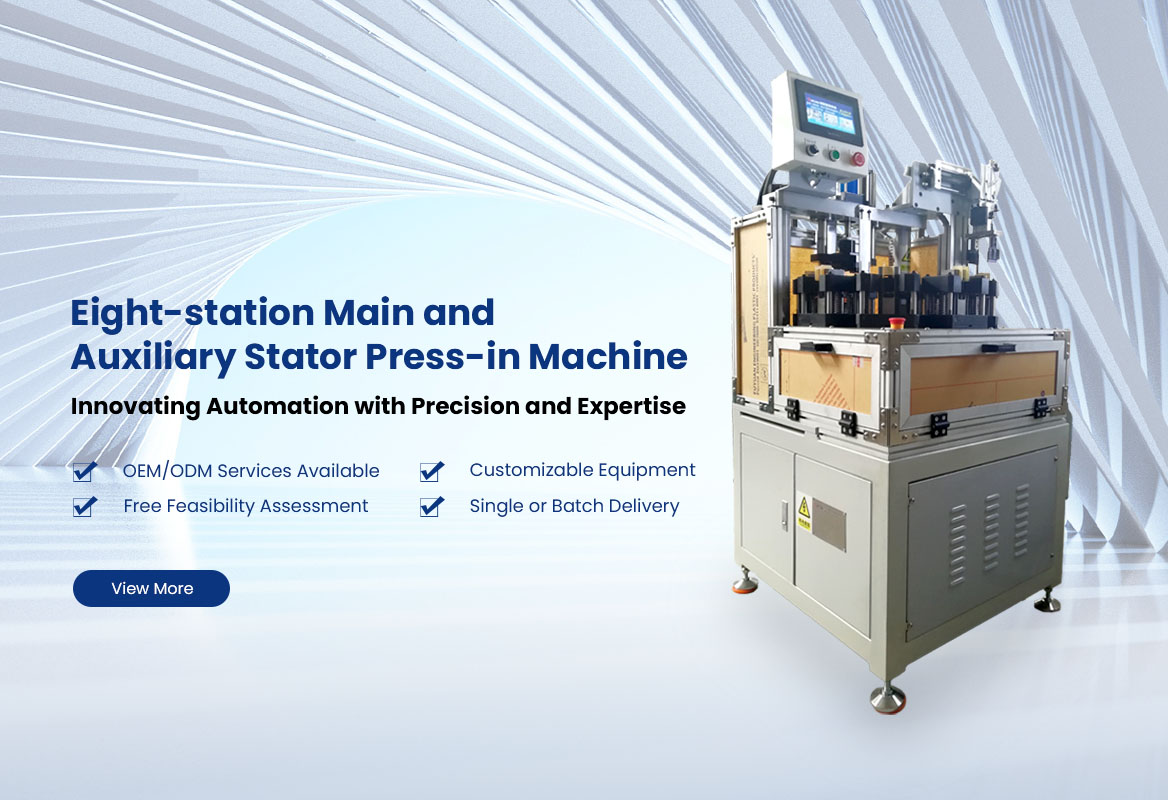
WECAN focuses on automation equipment and integrated production solutions, offering machines that cover multiple stages of motor assembly. Its product range includes stator press and insertion machines, servo press systems, rotor laminating machines, and complete automated production lines.
The company emphasizes process integration rather than isolated equipment supply. This approach helps manufacturers build a stable production system step by step, reducing risk during expansion and improving overall efficiency. With experience in automation design and system control, WECAN supports both standalone equipment upgrades and full production line planning.
Choosing a motor assembly machine requires a balance between technical requirements, production goals, and long-term operational considerations. Understanding the production process, evaluating automation level, and selecting a capable supplier are all essential steps.
A well-selected machine does more than complete a task. It becomes part of a stable, efficient production system that supports consistent quality and scalable output.