wecan01@wecan-machine.com
+86-18825990919
+86-07502632972

Industrial control systems are no longer just “the PLC box on the side of the machine.” In modern production, controls determine whether equipment can run stably at speed, switch jobs quickly, capture process data, and protect operators with predictable safety logic. For factories that rely on automation equipment, integrated control is often the difference between scalable output and constant troubleshooting.
WECAN positions itself as a manufacturer that develops automation equipment and industrial software control systems alongside hardware, with an in-house development team and production workshop support. This “machine + controls” capability is important because it reduces the integration gaps that commonly appear when mechanical structure, sensors, motion, and software are supplied by separate parties.
One of the most direct advantages of a well-designed industrial control system is repeatability. WECAN’s equipment descriptions highlight PLC-based control of stroke and operation parameters, paired with servo-driven accuracy. For example, WECAN’s Precision Servo Stamping Machine lists repeat accuracy of 0.02 mm and cycle efficiency of 4–5 seconds per piece, while emphasizing that the stamping stroke and operation are PLC-controlled.
When the control logic can precisely coordinate motion, pressure, timing, and alarms, it becomes easier to keep dimensional outcomes stable across long runs. That stability reduces rework risk, minimizes operator-dependent variation, and makes scaling output less fragile.
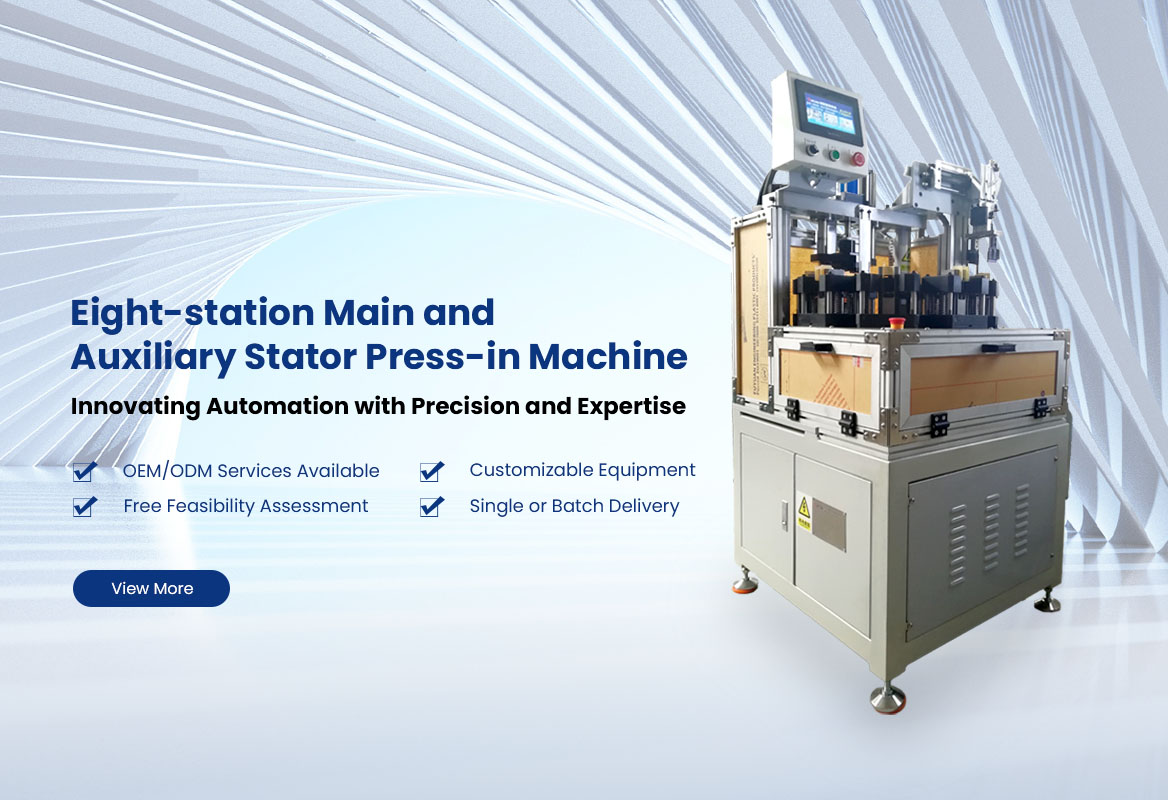
Automation only pays off when the control system truly sequences the workflow, reduces hands-on steps, and prevents repeated stops. WECAN’s motor equipment category describes multi-station systems designed to separate hands from key riveting stations, improving safety while simplifying operation, and it states efficiency can be three times that of manual operation for certain equipment. (WECAN)
In practice, a good control system delivers these gains by:
Synchronizing feeders, sensors, and actuators so stations do not wait on human timing
Using interlocks and error handling to stop the right module instead of halting the entire line
Keeping recipes and parameters consistent across shifts
Control systems affect not only speed, but also material utilization. In WECAN’s automation discussion for EPE processing, it notes that automated nesting and software-driven precision can push material utilization to over 95%, compared with around 85% in manual operations.
That gap is significant in any process where sheet, foam, or other engineered materials are a meaningful cost driver. When controls support programmable layouts, tracking, and parameter logging, it becomes much easier to identify scrap patterns and keep yield stable over time.
Downtime is expensive, and the cost is often underestimated because it includes missed output, labor idle time, material loss, and schedule disruption. A 2025 ABB press release summarizing a global survey reports that 83% of decision makers agree unplanned downtime costs at least $10,000 per hour, and 76% estimate up to $500,000 per hour, with many experiencing interruptions at least monthly.
WECAN’s content repeatedly ties modern automation to PLC + touch interface monitoring, recorded parameters, and even compatibility with industrial IoT platforms for long-term tracking and remote diagnostics. When controls are designed for visibility, the factory benefits from:
Real-time alarms that point to root causes faster
Parameter history that helps engineers reproduce issues
Networked diagnostics that reduce time-to-repair
Industrial control systems are also safety systems. WECAN’s own safety standards overview lists widely used frameworks that shape control design and validation, including ISO 12100 for risk assessment, ISO 13849 for safety-related parts of control systems, NFPA 79 for electrical standard practices, and functional safety standards such as IEC 62061 and IEC 61508.
A practical advantage here is export readiness: when control architecture is built with risk assessment, protective devices, and validation thinking from the start, later compliance work becomes more predictable and less disruptive to delivery.
Many factories struggle when product variety increases: changeovers get longer, quality drifts, and training becomes harder. WECAN emphasizes integrated control systems that allow parameter setting for different dimensions and patterns, and it notes servo-controlled systems can switch specifications quickly in certain applications.
From a manufacturer perspective, this is where control design becomes a “platform”:
Recipe management reduces changeover mistakes
Standardized HMI workflows shorten operator onboarding
Modular I/O and motion blocks simplify future upgrades
If you need OEM/ODM-ready flexibility, control system modularity and recipe logic should be treated as core deliverables, not optional add-ons.
| Control capability | What it improves | Practical result on the line |
|---|---|---|
| PLC sequencing + servo coordination | Repeatability and stability | Tighter tolerances, fewer defects |
| Recipe-based parameter control | Fast model switching | Shorter changeovers, less training burden |
| Data logging + monitoring | Troubleshooting speed | Less stop-time, clearer root causes |
| Safety-aligned control architecture | Risk reduction | Easier compliance validation |
| Software-driven optimization | Material utilization | Higher yield potential |
WECAN describes its scope as covering automation equipment, robot integrated applications, and industrial software control systems, supported by dedicated development teams and production workshops. This matters because the best control outcomes usually happen when the machine structure, sensors, motion design, and software logic are engineered as one system instead of stitched together after the fact.
If your goal is stable throughput, predictable quality, and fewer integration headaches, WECAN’s integrated approach to industrial control systems is designed to support that outcome—starting from how the machine runs today, and extending to how it will be monitored, optimized, and upgraded tomorrow.