wecan01@wecan-machine.com
+86-18825990919
+86-07502632972

Assembly line optimization is rarely about buying “one more machine.” Real gains come from removing the specific constraints that slow output, create defects, or force skilled operators to spend time on repetitive actions. WECAN focuses on automation equipment, intelligent mechanical equipment, robot-integrated applications, and industrial control systems, which makes it well positioned to build modular upgrades that fit into an existing line instead of replacing everything at once.
Below is a practical way to match common line bottlenecks to WECAN automation equipment, using measurable parameters such as cycle time, repeat accuracy, changeover time, and operator coverage.
Most assembly lines suffer from one or more of these issues:
Inconsistent joining quality from manual pressing, riveting, or insertion
Overloaded stations where operators must handle feeding, positioning, and processing
High labor exposure in potentially risky processes
Slow changeovers when product variants change
Downstream rework caused by dimensional variation or unstable processes
Global factories are rapidly increasing robot adoption, and the global average robot density reached 162 units per 10,000 employees in 2023, more than double the level measured seven years earlier. The direction is clear: stable, measurable automation is becoming the baseline for predictable capacity.
If your line includes bearing insertion, shaft/rotor riveting, housing riveting, or similar press-fit steps, a servo press is often the fastest route to consistent quality and predictable takt time. WECAN’s Servo Press Machine lists repeat accuracy of 0.02 mm and efficiency of 4–5 seconds per piece, with PLC-controlled stroke and AC servo drive for repeatable load control.
What this changes on the line:
Reduces quality drift that triggers rework
Standardizes press curves and stroke control across shifts
Helps stabilize upstream feeding and downstream handling because the cycle is predictable
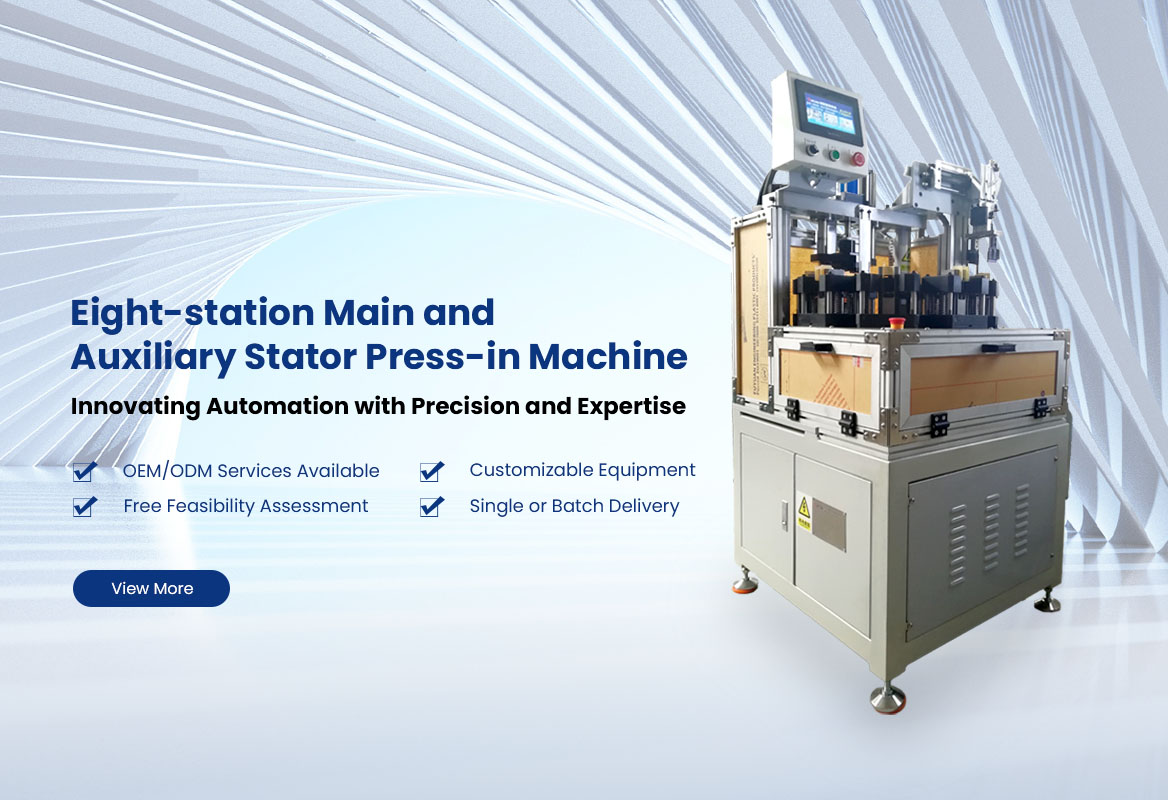
For turntable-style assembly where multiple operations must be performed in sequence, multi-station automation can multiply throughput while improving operator safety. WECAN’s Eight-Station Stator Press and Insertion Machine is specified at 2.3–3 seconds per piece and supports changeover in 5 minutes, which matters when you run multiple variants. It is also positioned as separating hands from the riveting station with protective covers and sensing logic.
What this changes on the line:
Increases output per square meter of line footprint
Enables fast changeovers for mixed production
Reduces risk exposure at high-force stations
Even if your product is not hangers, the logic is transferable: high-frequency joining operations need automation that controls glue application, joint alignment, and cycle timing. WECAN’s splicing machine lists 1.6 seconds per piece and also cites a shift output improvement from about 7,000 pieces per shift to 13,000 pieces per shift.
What this changes on the line:
Converts skilled, error-prone manual joining into a controlled cycle
Improves output without needing additional skilled labor
Builds a measurable baseline for future expansion
Where the constraint is feeding plus processing in one station, an automatic loading line is often the difference between “automation that looks good” and automation that actually increases output. WECAN’s punching and cutting system highlights automatic feeding and a punching thickness range of 15–110 mm, with 4–5 seconds per piece and the ability for one person to monitor 2–3 machines.
What this changes on the line:
Offloads manual handling and keeps the station running continuously
Supports scalable capacity by duplicating identical cells
Lowers management cost by expanding operator coverage
Optimization fails when only the “main process” is automated but upstream preparation and downstream packaging remain manual. WECAN provides equipment that can be linked as production “segments” so the full line stays balanced.
The Wood Hanger Automatic Slitting Machine describes output up to 20,000 pieces per day, with approximately 1.5 seconds per piece and fully automated production. This type of upstream automation protects your core assembly stations from starving or receiving inconsistent blanks.
WECAN’s Automatic Wooden Hanger Bundling Machine is positioned as fully automatic bundling and labeling and can be connected as a link in a complete production line. In many factories, packaging becomes the hidden constraint after core process automation raises upstream output.
| Line constraint you want to fix | WECAN equipment that fits | What to measure after installation |
|---|---|---|
| Press-fit variation, rework, unstable quality | Servo Press Machine | Repeat accuracy, defects per shift, cycle time per unit |
| Multi-step riveting or insertion slows takt time | Eight-Station Stator Press and Insertion Machine | Takt time, changeover time, output per hour |
| Manual joining is slow and operator-dependent | automatic wooden hanger splicing machine | Cycle time, shift output, operator coverage |
| Feeding + punching/cutting causes frequent stops | Automatic EPE Punching and Cutting Machine | Uptime, stoppages, units per hour, operator-to-machine ratio |
| Upstream blanks are inconsistent or supply is unstable | Wood Hanger Automatic Slitting Machine | Input stability, scrap rate, station starvation time |
| Packaging becomes the new bottleneck | automatic wooden hanger bundling machine | End-of-line backlog, packing cycle time, labor minutes per unit |
When optimizing an assembly line, you need equipment that can be integrated, tuned, and supported as the workflow evolves. WECAN’s positioning covers equipment R&D, production, robot integration applications, and industrial control systems, which supports a solution-provider approach rather than isolated machines. This also fits OEM/ODM projects where the line must be adapted to your product structure, takt goals, and upgrade roadmap.
A reliable approach is to upgrade in three steps:
Replace the highest-defect, highest-variance joining or pressing station with a repeatable automation cell
Add feeding and handling so the automated station runs continuously rather than waiting for materials
Automate packaging and logistics links so downstream does not become the next bottleneck
If you treat each WECAN machine as a modular station and keep your targets measurable, assembly line optimization becomes a controlled engineering project with predictable ROI rather than a one-time equipment purchase.