

Deburring often becomes a bottleneck when stamping or machining output grows faster than manual finishing capacity. Parts accumulate between processes, inspection becomes rushed, and operators spend more time correcting inconsistent edges.
Rotor balance depends on how accurately individual laminations are aligned, compacted, and maintained at the specified stack height. Misaligned sheets, uneven compression, angular deviation, and mixed lamination dimensions can shift mass away from the rotational center.
Rising output alone does not automatically justify a fully automated motor line. Automation becomes necessary when disconnected workstations create unstable cycle times, excessive handling, quality variation, or limited traceability.
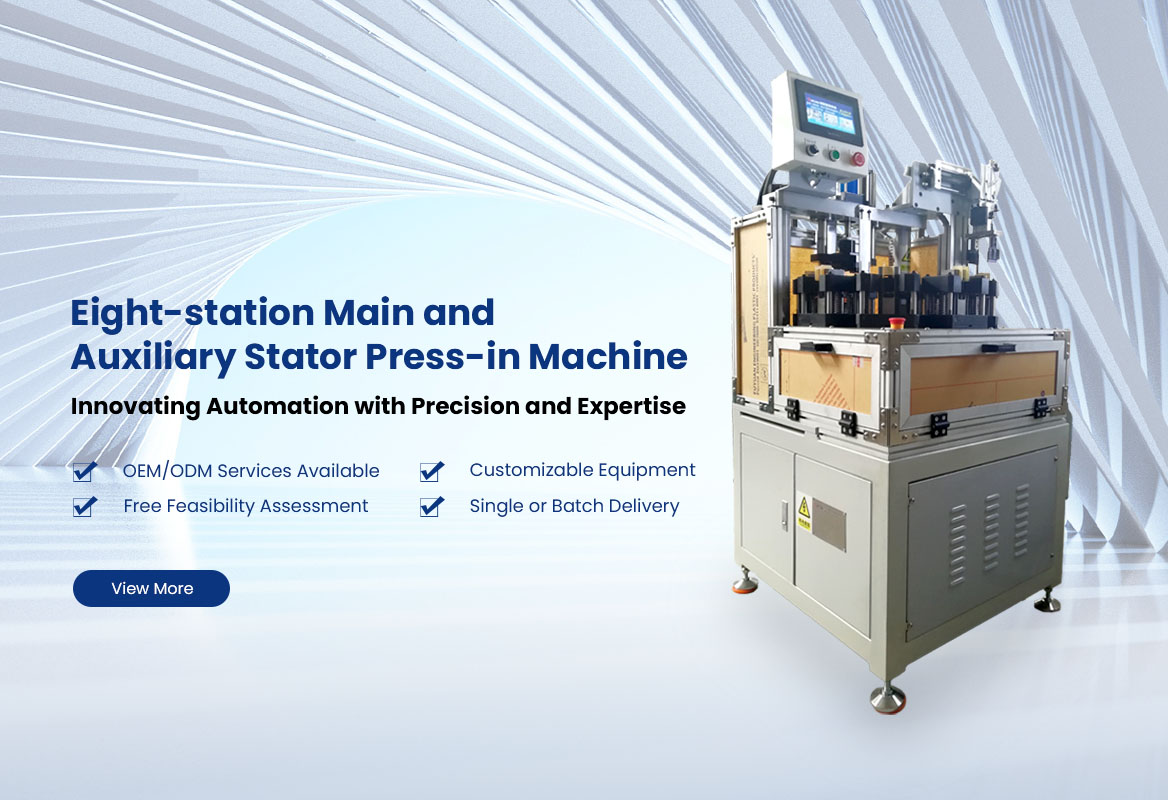
Stator riveting determines how securely the main and auxiliary stator components remain positioned during assembly and operation. Incorrect pressure, angular deviation, loose joints, or distorted laminations can affect air-gap consistency and create vibration, noise, or electrical performance variation.
Bed slat assemblies depend on uniform spacing, accurate nail placement, and stable fastening depth. When these factors vary, the finished bed board may become uneven, loose, noisy, or difficult to install inside the frame.
Installing a bearing and then securing it with a circlip may require only two operations, yet separating them across different workstations creates extra handling, waiting, and inspection. Parts can be mixed, bearings may shift before retention, and operators must repeatedly load the same shaft.
Bearing failures discovered during motor testing are not always caused by poor bearing quality. Many begin during assembly, when the bearing is pressed through the wrong ring, installed at an angle, contaminated, driven too deeply, or subjected to uncontrolled force.
Motor shafts, bearings, housings, rotors, and stator components must be pressed to controlled positions without deformation. Even a small deviation in force or insertion depth can create excessive bearing preload, loose riveting, rotor misalignment, or unstable motor operation.
Stator assembly errors often begin with small variations in component position, insertion depth, riveting pressure, or operator handling. These deviations may cause loose connections, distorted laminations, dimensional inconsistency, abnormal vibration, or difficulties during later motor assembly.
Premium watch, jewelry, perfume, and gift boxes are judged immediately by their surface appearance. Uneven gloss, polishing marks, edge burn, dust inclusions, and visible paint texture can reduce the perceived value of an otherwise well-made box.
Bed slats may look simple, but small differences in wood density, moisture, grain direction, thickness, or machining can significantly change their load-bearing performance. Without systematic testing, weak slats may enter the assembly line and cause deformation, noise, frame instability, or premature breakage.
A successful installation begins before the wooden hanger production line arrives. Buyers need to confirm floor space, foundation conditions, power, compressed air, dust control, material routes, operator access, and downstream packing. Missing one of these requirements can delay commissioning or prevent the line from reaching its planned output.